
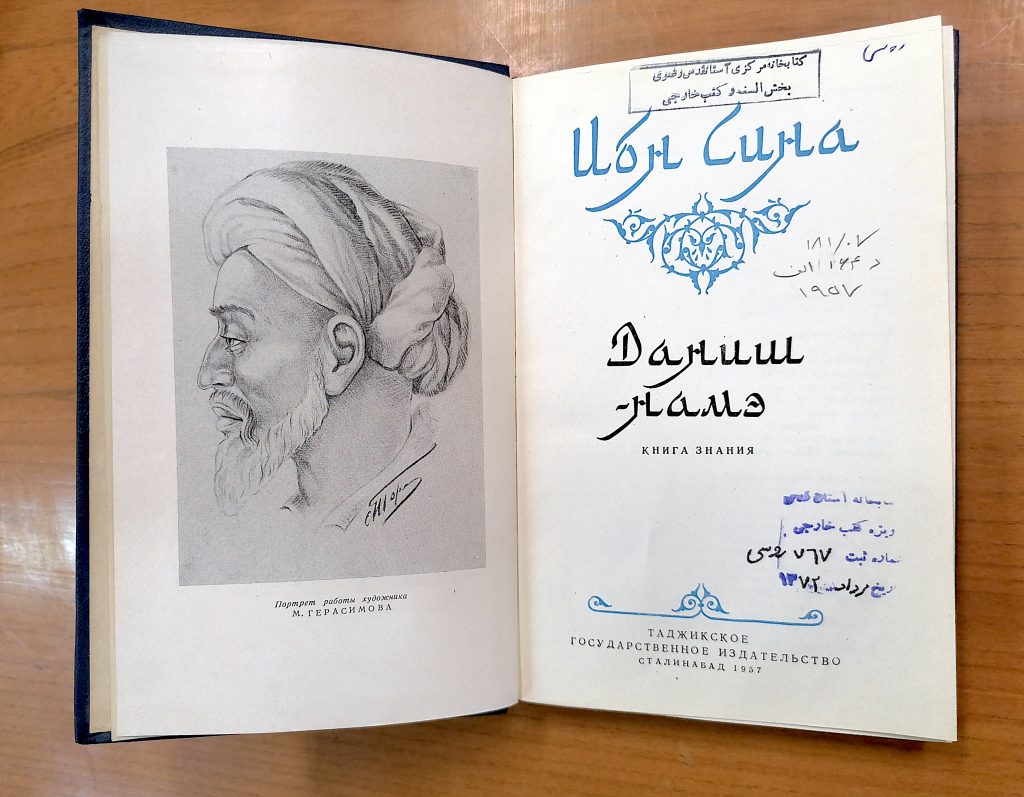

Avicenna’s “Daneshnameh” (Book of Knowledge)
Translated with an introduction by A.M. Bogoutdinov
Editor: M.-N. Osmanov
Year of Publication: 1957
Publisher: Academy of Sciences of the Tajik Soviet Socialist Republic
Language: Russian and Tajik, including Persian texts
Avicenna’s “Daneshnameh” is a treasure of knowledge and philosophy, translated into Russian for the first time. This ancient work symbolizes the scientific flourishing of Iran and Tajikistan and the long-standing cultural connection between the two civilizations.
This edition is based on a manuscript preserved at the Ferdowsi Library in Tajikistan, originally written around 1030 or 1034 CE, as well as printed versions published in Tehran.
✨ Unique Features of This Edition:
- Scholarly translation and editing by leading experts
- Artistically designed and visually appealing cover
- A reliable resource for enthusiasts of philosophy and the history of science
Readers will explore logic, metaphysics, natural science, psychology, and the interconnection of science and philosophy from Avicenna’s perspective.
We highly recommend this book to lovers of wisdom and philosophy!
⬇️ Share your thoughts about this enduring masterpiece with us.
💡Are you curious about Avicenna’s Life? Here is his Autobiography.
💡Are you interested in reading about Avicenna’s Logic on Theology?
From Imam Reza’s Library at Astan Quds Razavi
Summary of Avicenna’s “Book of Knowledge” and Its Teachings for the Reader:
📚 Main Themes of the Book:
- Logic (Introduction to the principles of reasoning, syllogism, definition, and valid methods of cognition)
- Metaphysics (Existence, God, substance and accident, cause and effect, philosophical cosmology)
- Natural Science (Physics, motion, bodies, the four elements, natural phenomena)
- Psychology (Levels of the soul, sensory and intellectual perception, the relationship between body and soul)
- Philosophical Psychology (Faculties of the mind, the Active Intellect, sleep and dreams, epistemology)
💡 What Does the Reader Learn?
- Developing Logical Thinking: How to reason and identify fallacies.
- Understanding Ontological Concepts: Answers to questions such as “What is existence?” and “What is the nature of God?”
- Familiarity with Nature and Phenomena: Avicenna’s theories on motion, elements, and the cosmos.
- Understanding the Human Soul: Levels of perception from senses to intellect and humanity’s place in the world.
- Connecting Science and Philosophy: An integrated perspective on various fields of knowledge through a rational approach.
✨ Key Insight:
This book is not merely a historical work; it is a gateway to the world of Islamic philosophy, demonstrating how rationality can be used to comprehend existence and humanity.
For thinkers, philosophy students, and enthusiasts of the history of science, it serves as a simple yet profound resource.